Gender-intentional design in business and investment is increasingly demonstrating commercial value. As part of 2X Global's climate finance deep dive on gender lens investing (GLI), we recently held two fireside chats showcasing Connector-supported enterprises Amaati and AlltimeFresh and impact investors I&P and Root Capital. Throughout the discussion, they shared their experiences working at the intersection of gender and climate, together making the case for a dual-lens approach.
A common thread ran through both discussions: the opportunity in applying the dual-lens approach is real, but only attainable if businesses and investors are willing to design for it. Alexandre Ponton, Advisory Manager at I&P, expressed this well, saying, “We need to shift the narrative to think about gender and climate integration not only through the lens of impact, but also through the lens of business and investment opportunity.”
The business opportunity in a dual lens approach
Amaati in Northern Ghana and AlltimeFresh in Nigeria are two examples of agribusinesses that identified and embraced the business opportunity in a dual-lens approach and have thrived as a result.
For Amaati, the opportunity arose through an overlooked, low-cost, climate-resilient supply base. In Northern Ghana, fertile lands are highly contested by men. The marginal, infertile plots that are left become available to women cheaply and on longer terms. Amaati saw a business opportunity in a crop that aligns with this reality. They centred their business on fonio, a drought- and flood-tolerant grain that thrives in poor, rocky soils, providing a low-cost supply base that holds firm where water-intensive crops like maize would typically fail. “Fonio can literally grow anywhere. [It] serves as crop insurance for climate shocks”, shared Co-Founder Salma Abdulai. “At least with Fonio, women can start something”, she adds.
For AlltimeFresh, two facts stood out to Founder and CEO Eneotse Unoogwu. First, women producers are too fragmented and lack the resources and training to supply the premium market reliably. Second, while women make up 70% of informal traders in Nigeria, they struggle to source high-quality produce that they can sell at a premium. She found an opportunity in bridging the two to fix a supply gap through AlltimeFresh's block-farm model, which groups women to share resources across neighbouring plots.
Unoogwu noted the high demand for this model among producers and traders. "Adoption is not an issue. The speed is very high. Sometimes we can't cope with the number of women who want to join." That adoption readiness reflects wider evidence that when controlling for resource contraints, women are quick to adopt new practices and stick with them at equal or higher rates than men, such as taking up climate-smart approaches.
The commercial opportunity in serving women farmers can only be captured by designing around the reality that they farm under more constrained conditions than men. That means recognizing that women farmers have less to fall back on when climate shocks hit and is partly why female-headed rural households in low- and middle-income countries lose significantly more income to climate shocks each year than male-headed ones. A business model built without accounting for these differences will default to farmers who already hold greater access to land, finance, and markets, who are typically men. This results in an untapped commercial opportunity and excludes women from the green economy and the value it creates.
"Adoption is not an issue. The speed is very high. Sometimes we can't cope with the number of women who want to join."
Eneotse Unoogwu, Founder and CEO, AlltimeFresh
How can agribusinesses design for women?
Amaati and AlltimeFresh's experiences illustrate three ways to design for women's realities.
1. Prioritize women’s agency: As crops become more lucrative and market-oriented, women tend to lose decision-making control over them, and high-value cash crops become defined as male domains. For Amaati, choosing a non-cash crop that sat outside of this dynamic gave control back to women, resulting in a committed supply base. As Abdulai put it, “it’s her crop, it's her money, it's her decision.” Her business did not confine women to non-cash crops, but seized the opportunity in the crops women already control, pairing them with training, market access, and fair prices, while also making cash-crop cultivation more accessible to women.
2. Pool resources to maximize productivity: AlltimeFresh is designed around providing women with resources that they cannot afford alone. Women producers farm on scattered, under-resourced plots, and individually, as Unoogwu put it, "cannot afford a solar irrigation system, land preparation, even things as small as nursery trees." The block-farm model removes the affordability barrier by grouping women to share infrastructure under supervision. By combining shared infrastructure with training, they are turning fragmented smallholders into a cost-effective, dependable, quality-assured supply base.
3. Consider every stage of the value chain: Both business models have been designed to make the idea redunant that women appear too risky to be reliable suppliers. Amaati increases the stability of its value chain by providing women with seed financing and mechanization to increase production. The company also aggregates and processes their grain. As Abdulai explained, “if the woman wins, we get a reliable supply of our raw materials, so it’s a win-win”. Crucially, AlltimeFresh also looks to women as customers, and provides a better value solution for women traders in lucrative local markets, where most of Nigeria's produce is sold, by distributing directly through their solar-powered cold storage network.
“If the woman wins, we get a reliable supply of our raw materials, so it’s a win-win”.
Salma Abdulai, Co-Founder, AmaatiThe investment opportunity in a dual lens approach
For the investors in both sessions, a dual-lens approach should integrate women across the supply chain as farmers, customers, and employees, going beyond only focusing on women-led businesses. Models built around the extra support women require come with added costs, however, Ponton framed this as an investment rather than a deterrent. “There's operational strain, whether it's data collected or the different frameworks implemented, but then there's that opportunity of deepening your understanding and making better investment decisions." He specified that understanding gender dynamics in agriculture sharpens how investors assess adoption and credit repayment profiles, and how they tailor products to women’s needs.
That understanding shifts the focus from treating a segment as a source of risk to recognizing it as an opportunity. It changes how businesses are designed and how investors choose to finance them. "When we tell SMEs to adopt more of a gender lens, they should also consider that it helps them understand half of their consumer base. It helps them make better decisions and design [a] better product," he noted. "I would also argue that an investor that can better understand that segment can better develop a competitive advantage."
Leonor Gutiérrez, Director of the Women in Agriculture Initiative (WAI) at Root Capital, noted the importance of building operational capacity throughout the supply chain, saying, "There are microloans that can start at fifty or a hundred dollars. This is the seed that makes everything else happen. When we are sure that this basic infrastructure exists, and that we have closed the gap at this level, then we can ensure that money can reach the farm level.”
"When we tell SMEs to adopt more of a gender lens, they should also consider that it helps them understand half of their consumer base. It helps them make better decisions and design [a] better product."
Alexandre Ponton, Advisory Manager, I&PHow can investors design for women?
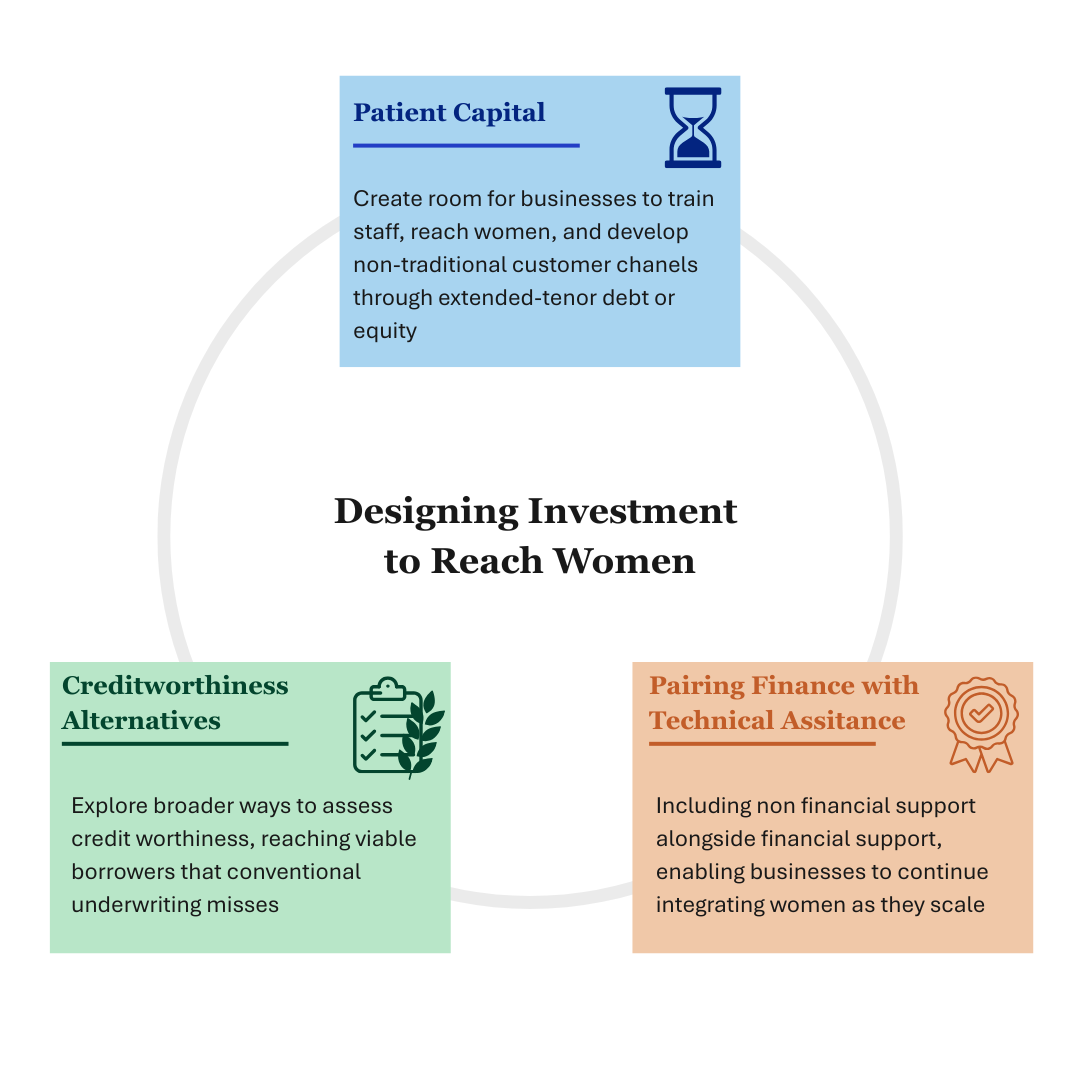
Investors looking to capture this opportunity will need to adjust the terms on which capital is offered. Three characteristics stand out.
1. Patient capital that gives these models the time they need to build. Extended-tenor debt or equity creates room to reach women farmers, develop non-traditional customer channels, and train staff properly. These investments may not generate immediate returns, but they create the conditions for more reliable long-term revenue.
2. Alternative pathways to creditworthiness. Broadening how this is assessed enables investors to reach viable borrowers that conventional underwriting misses. Standard lending criteria lean on established relationships, collateral, and credit histories that women founders are less likely to have. Alternative evidence such as harvest histories, utility payments, and mobile money records, alongside cash flow-based assessments or group guarantees and movable collateral such as livestock or stored harvests, can build a more complete picture of risk.
3. Pairing finance with technical assistance. Non-financial support helps these businesses to continue integrating women as employees, customers, and suppliers as they scale. Root Capital treats this as part of their offering, bundling business training with lending. For Gutiérrez, it starts with asking simple questions. "We need to ask women directly what is that they need, [and] what is that they're lacking."
The path forward for the sector
Women farmers are a critical yet underserved market with strong commercial and climate-resilience potential. Agribusinesses that integrate women across their value chains are underrepresented in climate portfolios due to ill-suited fund structures and systematic mispricing. When capital is deployed using the right instruments, timelines, and infrastructure to support women, returns are competitive for both investors and agribusinesses. The impact follows from the same design. A model built around women strengthens the domestic food systems they supply, builds resilience around climate shocks, and improves women’s access to economic opportunities. Continuing to overlook these investments is where the real risk lies.
Closing off the fireside chat, Gutiérrez muses, “What are the main barriers for women in climate finance? We have reports, we have data, we have case studies. Those are just numbers if we are not brave enough to get into the arena."